Quantitative PEth measurement from whole blood –
fast. reliable. reproducible. (CE-IVD)
The “PEth from whole blood” test kit is intended for professional users in clinical and forensic laboratories. It enables the quantitative determination of PEth 16:0/18:1 and PEth 16:0/18:2 using LC-MS/MS. The test kit is intended to be used for patients in whom the concentration of 16:0/18:1 PEth and 16:0/18:2 PEth in the whole blood is of clinical importance, for diagnosis of chronic alcohol abuse, and for monitoring alcohol consumption.
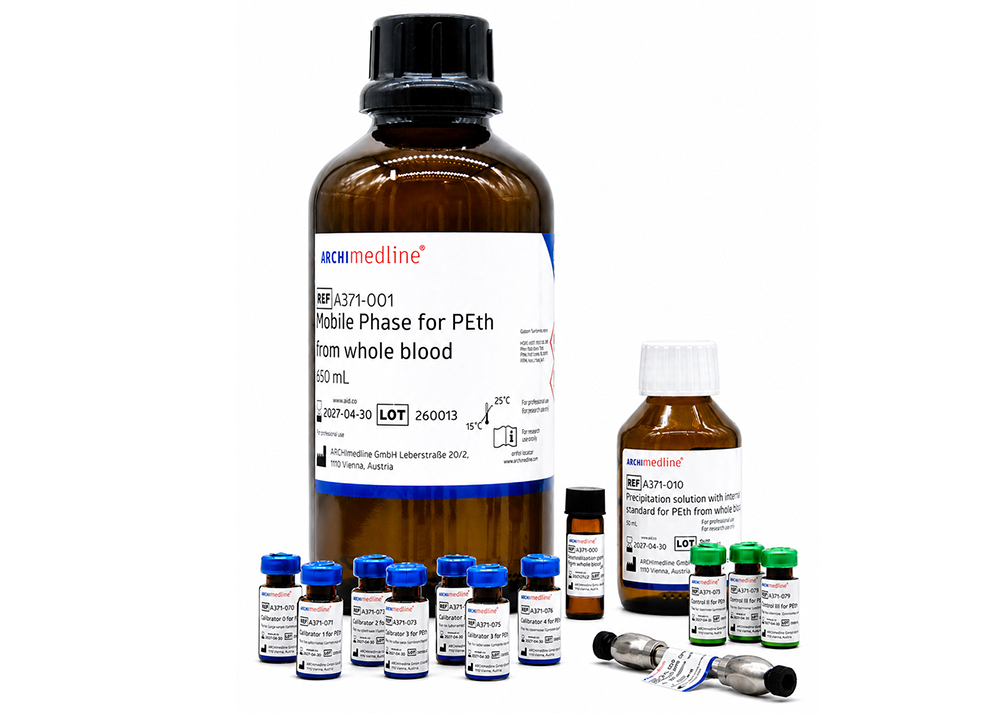
Why “PEth from whole blood”?
Designed for medium to high routine throughput, clear decision-making criteria, and seamless integration into existing LC-MS/MS workflows.
LC‑MS/MS‑Kit for 330 Assays
Scalable for routine laboratories and projects with high sample volumes.
Expanded range of analytes
Quantification of PEth 16:0/18:1 and PEth 16:0/18:2.
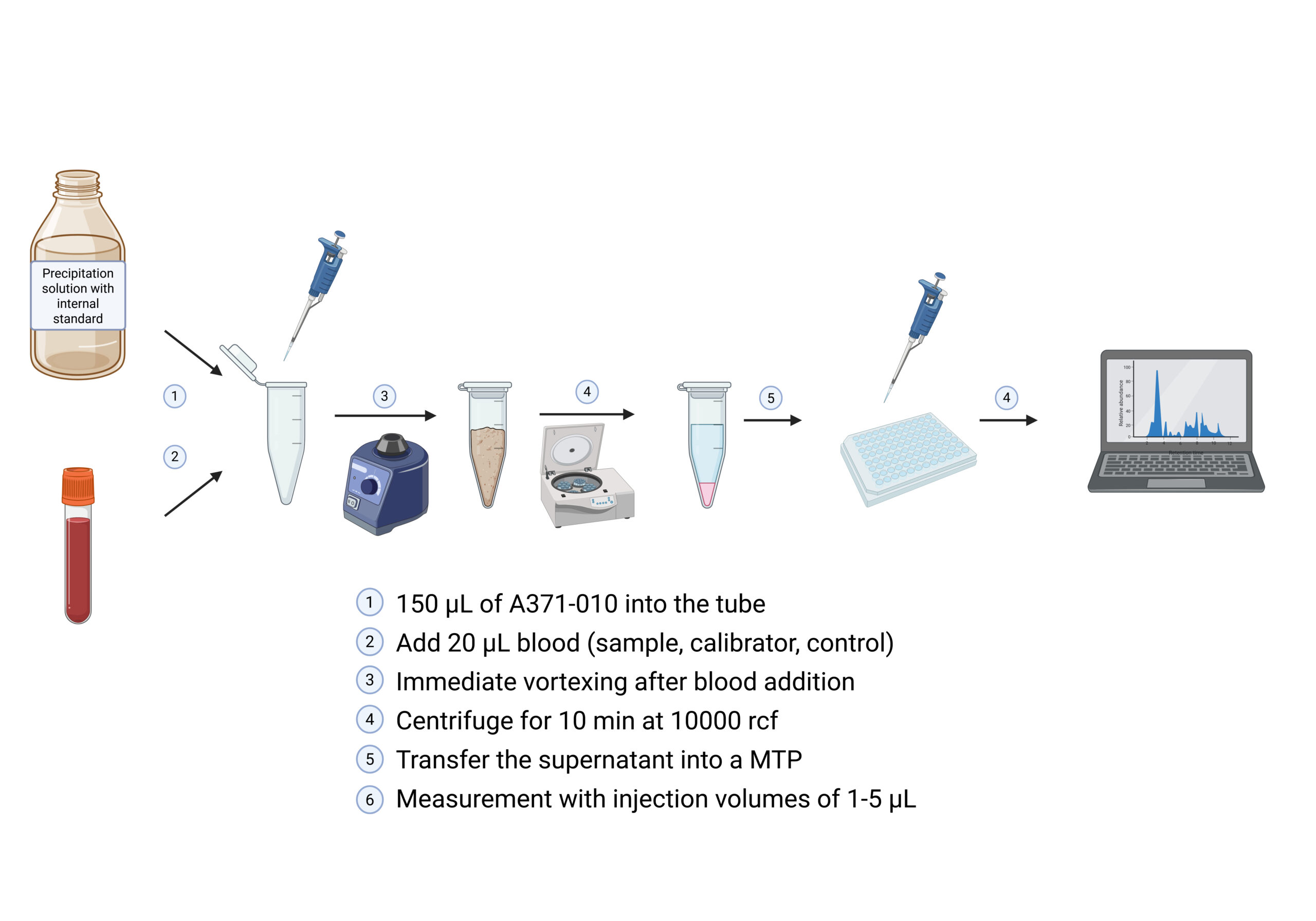
Easy sample preparation
(1,5 mL tubes)
Compatible with standard laboratory equipment.
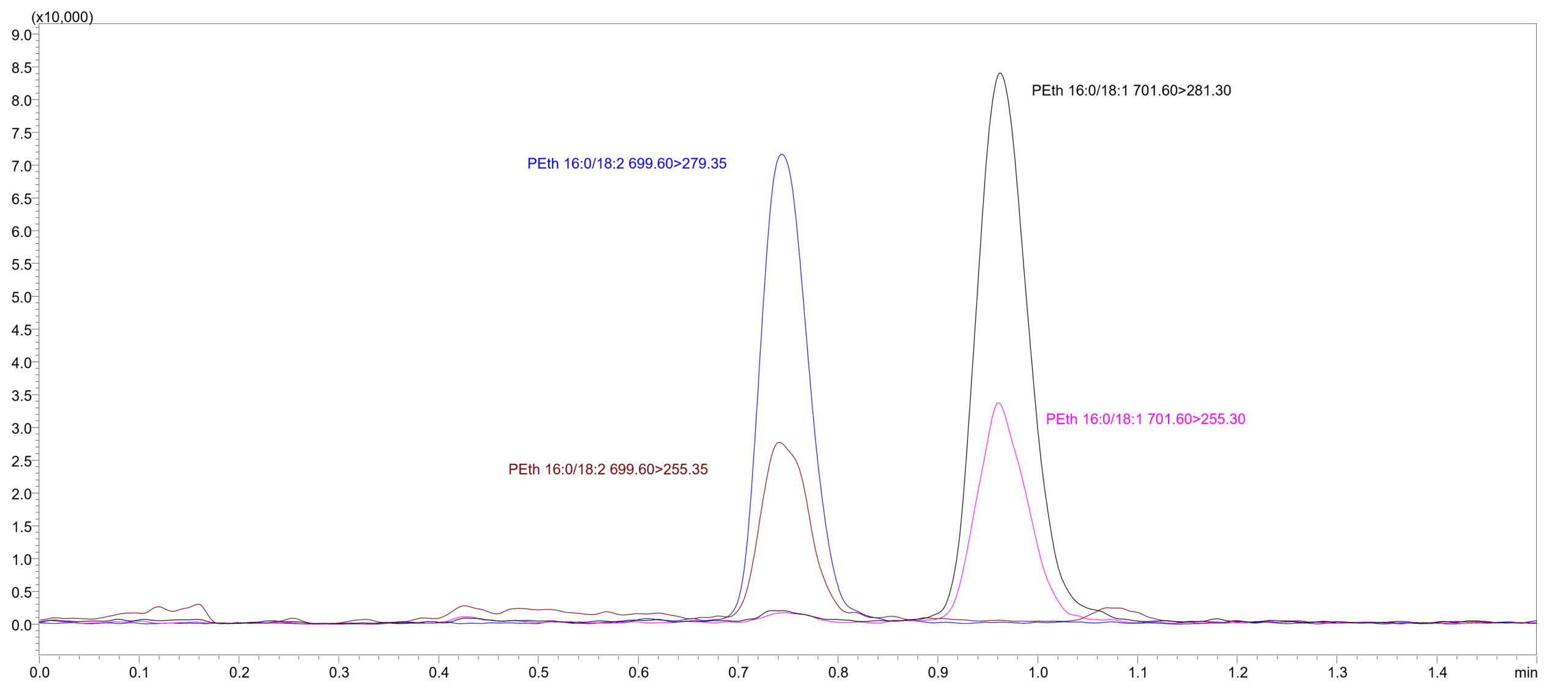
3-minute chromatographic separation
With a 3.2-minute injection interval for efficient sequences.
7-point calibrators & 3-point controls
Reliable quantification and quality control in routine operations.
Extended calibrator range
Additional calibrators and controls are available.
Components available separately
Flexible reordering – including calibrators and control solutions.
Technical Data & Specifications
Analytes
PEth 16:0/18:1 (main analyt)
PEth 16:0/18:2 (additional)
Matrix: Human whole blood
Measurement principle: LC‑MS/MS
Throughput & Cycle Times
Chromatography: 3:00 min
Injection interval: 3:20 min
Kit size: 330 Assays
Calibration & QC
Calibration: 7-point calibrators
Quality controls: 3‑point‑controls
Extended calibration up to 4000 ng/mL (optional)
All components are also available separately.
Sample preparation
Compatible with standard pipettes and common centrifuge technology
Two-step protocol in 1.5 mL reaction tubes
Simple, rapid sample preparation for routine laboratories
Compatibility & Integration
Detailed IFU/method document available (upon request)
Suitable for use on LC-MS/MS systems with standard ESI sources
Can be integrated into LIMS workflows
Performance data
PEth 16:0/18:1
| Linearity | 4,9 – 6373,8 ng/mL |
| Measuring range | |
| A371-011 A371-011 with A371-080 A371-011 with A371-082 | 4,9 – 1000 ng/mL 4,9 – 3000 ng/mL 4,9 – 4000 ng/mL |
| LOD | 2,1 ng/mL |
| LOQ | 4,9 ng/mL |
| Precision | CV [%]; n=160 |
| Level 1 Level 2 Leve 3 | 8% 5% 5% |
| Trueness | abs BIAS [%] |
| Arvecon 3/25 A Arvecon 3/25 B | 5,5% 6,9% |
PEth 16:0/18:2
| Linearity | 4,1 – 6109,4 ng/mL |
| Measuring range | |
| A371-011 A371-011 with A371-080 A371-011 with A371-082 | 4,1 – 1000 ng/mL 4,1 – 3000 ng/mL 4,1 – 4000 ng/mL |
| LOD | 1,4 ng/mL |
| LOQ | 4,1 ng/mL |
| Precision | CV [%]; n=160 |
| Level 1 Level 2 Leve 3 | 6% 5% 5% |
| Trueness | abs BIAS [%] |
| ACQ 724 | 5% |
Workflow
Ordering information
| Ordering number | Description | Quantity/Unit |
| A371-001 | Mobile Phase for PEth from whole blood | 650 mL |
| A371-006 | Optimization mix for PEth from whole blood | 2 mL |
| A371-010 | Precipitation solution with internal standard for PEth from whole blood | 50 mL |
| W001-01 | Washing solution 001 | 1000 mL |
| A371-011 | Calibrator set – Level 0 – 6 for PEth from whole blood | 7 x 1 x 250 μL |
| A371-012 | Control set – Level I – III for PEth from whole blood | 3 x 2 x 250 μL |
| A371-090 | HPLC column for PEth from whole blood | 1 pcs |
| A371-091 | HPLC column 2 for PEth from whole blood (optional) | 1 pcs |
| A371-080 | Calibrator 7 for PEth from whole blood (optional) | 1 x 1 x 250 μL |
| A371-082 | Calibrator 8 for PEth from whole blood (optional) | 1 x 1 x 250 μL |
| A371-081 | Control IV for PEth from whole blood (optional) | 1 x 1 x 250 μL |
Frequently Asked Questions
What is PEth?
Phosphatidylethanol (PEth) is a direct biomarker of alcohol consumption that forms in red blood cell membranes. Measuring it in whole blood allows for an assessment of long-term drinking patterns, unlike short-lived markers.
Who is this test intended for?
For professional users in clinical and forensic laboratories where the concentration of PEth 16:0/18:1 and PEth 16:0/18:2 in whole blood is relevant.
What results does the kit provide?
Quantitative results (LC-MS/MS) for the PEth species 16:0/18:1 and 16:0/18:2, based on a 7-point calibration and accompanying 3-point controls.
Can sample preparation be automated?
We are currently working on automating the sample preparation process. More information will follow.
Clinical background
PEth is primarily detected in red blood cells (RBCs), where it integrates into the phospholipid bilayer of the membrane. It is formed through the enzymatic reaction facilitated by phospholipase D, which catalyzes the conversion of phosphatidylcholine to PEth in the presence of ethanol. This process does not occur in the absence of alcohol, which is why PEth has gained prominence as a more reliable marker of alcohol consumption compared to other substances, such as breath alcohol tests or urine alcohol metabolites.
Detection Window and Sensitivity
PEth’s advantage lies in its longer detection window. It remains detectable for up to 2-3 weeks following heavy alcohol consumption, depending on the amount of alcohol consumed. Other markers such as blood ethanol or breath alcohol only provide information on recent consumption (within hours), while PEth levels continue to reflect alcohol use days after ingestion. This extended window makes PEth particularly useful in detecting alcohol use in chronic alcoholics or individuals undergoing alcohol treatment programs. Moreover, PEth levels correlate directly with the quantity of alcohol consumed, enabling clinicians to assess the extent of alcohol use.
PEth as a Marker of Chronic Alcohol Consumption
Chronic alcohol consumption can lead to various health complications, including liver disease, cardiovascular problems, and neurological impairments. Monitoring alcohol intake is crucial in both the diagnosis and management of these conditions. PEth provides a more accurate measure of alcohol intake over time compared to other markers, such as gamma-glutamyltransferase (GGT) or mean corpuscular volume (MCV), which are often used but less specific. Clinical studies have shown that PEth is highly sensitive in detecting heavy drinking in both short- and long-term consumption scenarios, which is important for managing patients with alcohol-related disorders. A study by Viel and colleagues (2012) demonstrated that PEth was able to detect alcohol consumption in chronic drinkers, with high sensitivity and specificity. The study found that PEth was detectable in nearly 90% of subjects who consumed alcohol regularly, making it a more reliable indicator of alcohol use than traditional biomarkers.
PEth in Alcohol Treatment Programs
In alcohol dependence and recovery programs, monitoring adherence to abstinence or reductions in alcohol consumption is essential. PEth testing has been integrated into several clinical treatment regimens, particularly in settings where long-term abstinence is crucial, such as rehabilitation centers. PEth testing allows clinicians to objectively assess whether a patient has relapsed or resumed alcohol consumption, providing valuable information for adjusting treatment plans. Research published by Helander et al. (2019) supports the use of PEth in detecting alcohol use in patients undergoing detoxification, showing that PEth testing can guide clinicians in modifying treatment strategies based on the patient’s alcohol use.
Send us a message.
 GmbH
GmbH